


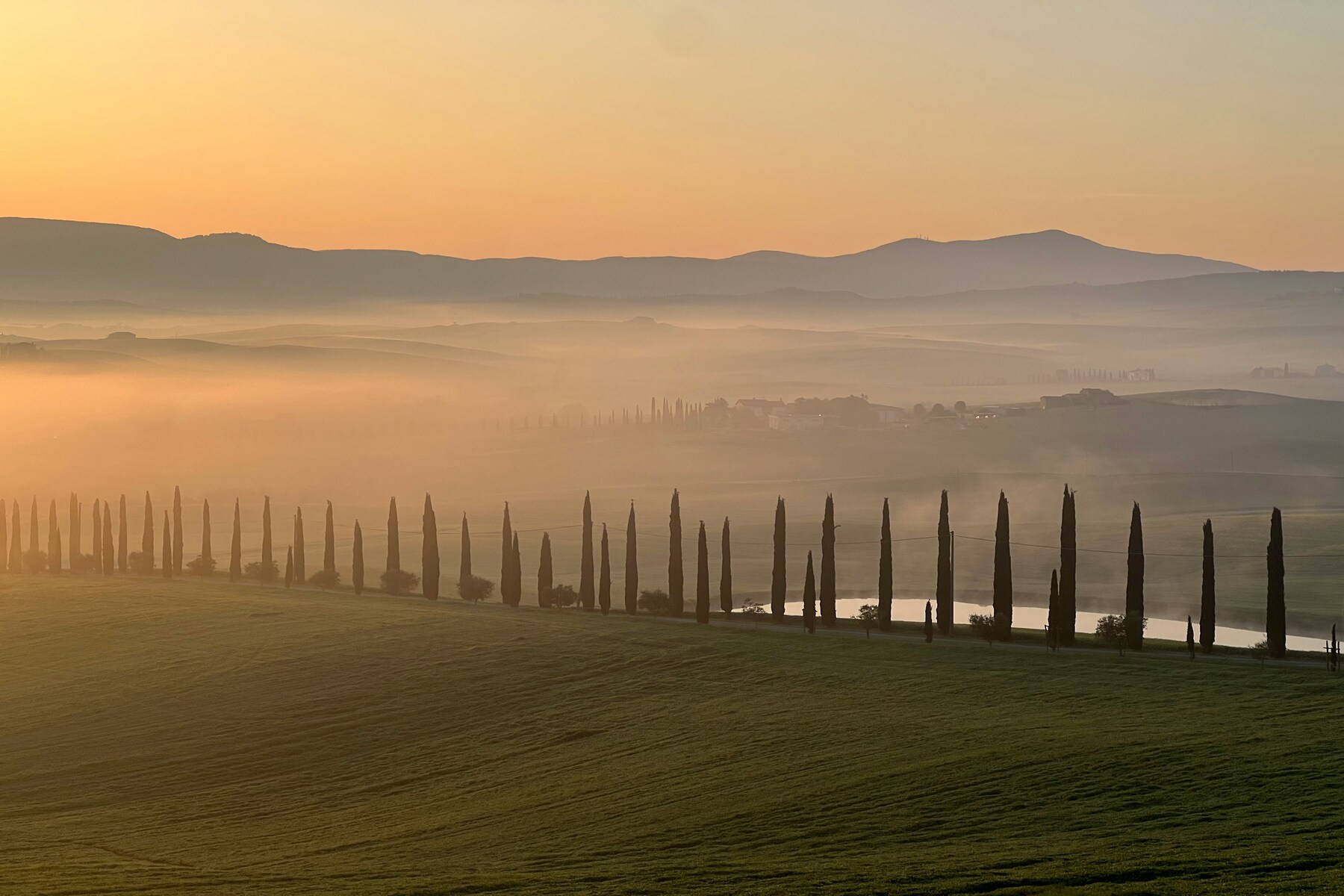
The sound of the gravel—the strade bianche—crunching under tires is the first sign that the rhythm of your day has fundamentally shifted. In the Val d’Orcia, speed is a localized offense. As you crest a hill near Pienza, the landscape opens into a vast, undulating sea of clay and wheat, punctuated by the iconic, solitary huddles of cypress trees that have stood as silent sentinels for centuries. There is no urgency here. The air carries the scent of sun-baked earth and ripening Sangiovese grapes, and for the first time in a long time, the horizon feels like an invitation rather than a boundary.
The Pulse of the Sienese Clay
To be in the Val d’Orcia is to exist within a Renaissance painting that refuses to dry. Unlike the dense, wooded hills of Northern Chianti, this southern stretch of Tuscany is defined by its openness. The “vibe” is one of profound, pastoral peace. It is a landscape sculpted by the hands of farmers and the whims of the seasons, a UNESCO World Heritage site that manages to feel like a well-kept secret despite its fame.
As the afternoon matures, the light transforms that locals call the “golden hour,” though it feels more like a liquid amber flooding the valley. The shadows of the rolling hills stretch and deepen, turning the bright green of spring or the burnt gold of autumn into a landscape of velvet ridges. There is a specific stillness that settles over the vineyards at this hour—a moment where the wind drops and the only sound is the distant chime of a bell from a hilltop hamlet. It is a place that doesn’t just ask for your attention; it demands your presence.
The Geography of a Shared Bottle
Romance in the Val d’Orcia is not a grand, choreographed event; it is found in the quiet geometry of a shared table. The emotional heart of this journey is the ritual of the sunset wine. There is a visceral resonance in sitting on a weathered stone terrace, the heat of the day still radiating from the masonry, and uncorking a bottle of Brunello di Montalcino or a Vino Nobile from nearby Montepulciano.
For a couple, the intimacy lies in the shared pace. As the wine breathes, so do you. The act of pouring a glass as the sun dips behind the profile of Mount Amiata becomes a ceremony of reconnection. You aren’t just tasting the fruit; you are tasting the specific volcanic soil, the rain of the previous winter, and the slow passage of time. The conversation naturally slows to match the descent of the sun. In this light, with the valley turning a bruised, beautiful purple, the complexities of life elsewhere seem to dissolve into the simple, tactile reality of the glass in your hand and the person across from you.
Mastering the Tuscan Pace
To truly capture the soul of the Val d’Orcia, you must resist the urge to “do” Tuscany. The secret to a sophisticated experience is to stay in an agriturismo—a working farm estate—located specifically between San Quirico and Castiglione d’Orcia. This central positioning allows you to witness the light change across the valley without ever having to rush.
The most evocative time to visit is late May, when the valley is an impossible shade of emerald, or late September, when the harvest brings a frantic, joyful energy to the air. Avoid the midday sun by exploring the small, stone-walled villages like Monticchiello in the early morning. Most importantly, leave your evenings unplanned. The best sunsets aren’t found at the famous viewpoints listed in guides, but on the side of an unmarked dirt road, with a bottle of local wine and the realization that the most beautiful things in life require absolutely no hurry.