

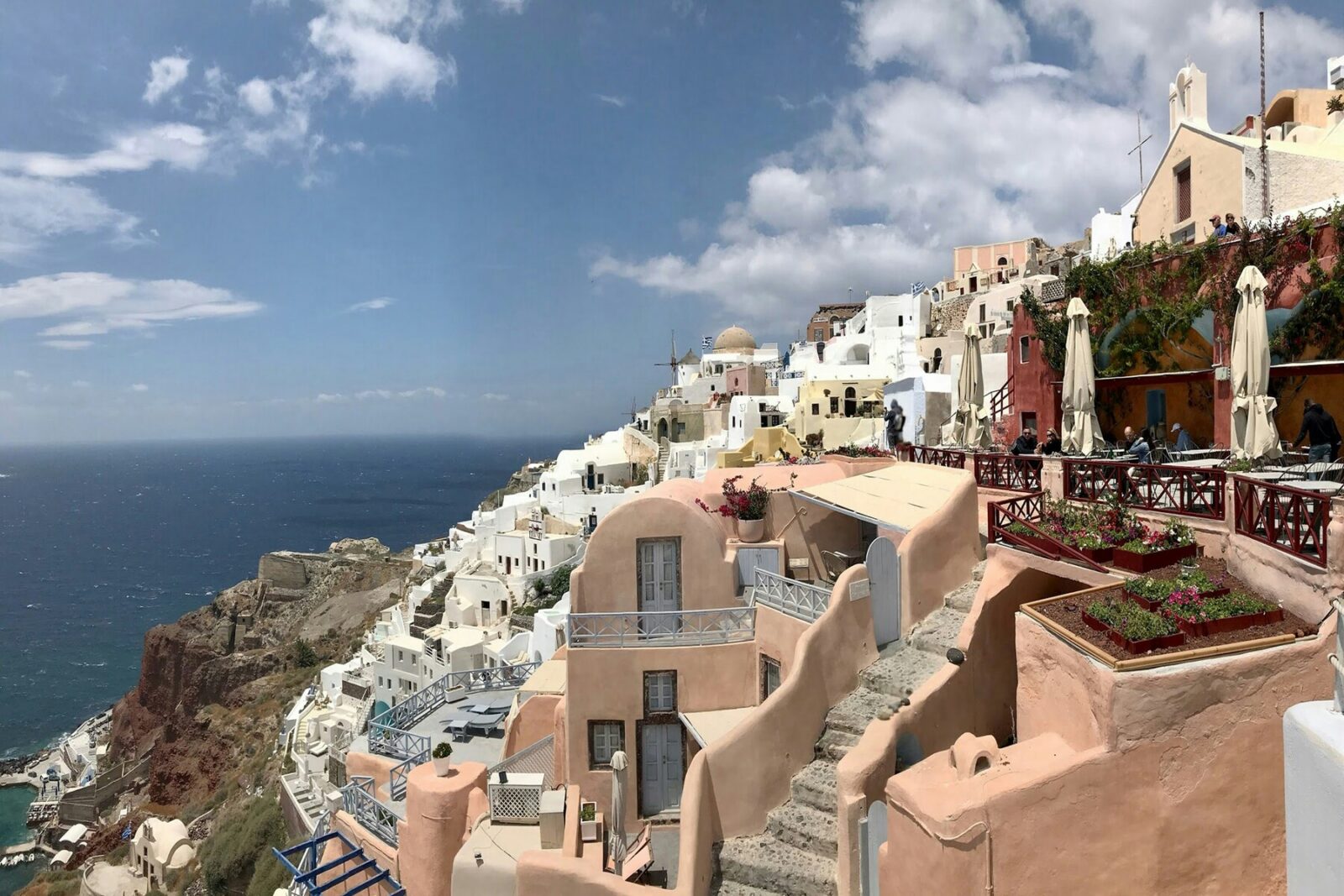
The white stone of the terrace stays warm long after the sun begins its final, heavy descent. If you press your palm against the lime-washed wall, you can still feel the ghost of the afternoon heat—a sharp contrast to the rising breeze coming off the Aegean. Most people experience a Santorini sunset as a collective event, a crowded ritual performed at the tip of the Oia castle where elbows jostle for space and shutters click in a frantic chorus. But for those who seek something more than a photograph, the experience shifts from a spectacle to a conversation. It becomes a weight you feel in your chest, especially when shared in the quiet gravity of a pair.
The Architecture of a Shared Silence
Santorini is a place defined by what is missing. The caldera itself is a giant, water-filled absence—the remains of a mountain that blew itself apart thousands of years ago. When you sit on a private terrace in Oia, you are perched on the rim of a jagged, beautiful scar. This history gives the island’s beauty a visceral edge; it is a precarious, fragile kind of elegance that mirrors the vulnerability of a deep emotional connection.
As the sun dips lower, the color of the island changes in deliberate stages. The blinding white of the midday sun softens into a creamy ochre. The church domes start to deepen from sky-blue into a royal indigo. From this vantage point, the village of Oia looks like a spill of sea salt across red volcanic rock. There is a specific silence that settles over the cliffs once you move away from the main pedestrian arteries. You can hear the distant hum of a boat motor far below and the wind catching the corners of a linen umbrella. It is a “vibe” that feels both ancient and entirely personal, a backdrop designed for things left unsaid.

Intimacy on the Edge
True romance in Santorini isn’t found in the grand gestures of a travel brochure; it is found in the geography of intimacy. It’s the way the light turns skin into a golden hue, the way the wine in your glass looks like liquid amber, and the realization that you are both very small in the face of such a massive horizon.
For couples, the most evocative way to lean into this is to abandon the maps and wander the lower “donkey paths” of Oia two hours before sunset. These narrow, winding veins of the village drop away from the marble-paved main street, leading you past blue-painted gates that hide secret gardens. In these quiet pockets, the only sound is the wind and the occasional chime of a distant church bell.
The experience is anchored by the ritual of a private, terrace-side tasting of Assyrtiko—the island’s crisp, volcanic white wine. Pairing this with local Hloro cheese and sun-dried tomatoes creates a sensory loop: the salt of the earth, the sight of the sinking sun, and the presence of the person beside you. As the sun finally touches the water, the sea seems to catch fire for a brief, flickering minute. For a couple, this transition acts as a silent vow—a shared memory that requires no filter to maintain its power.
To capture this feeling, you must resist the urge to document every second. Put the phone face down and simply watch the shadows grow. To avoid the frantic energy of peak summer, aim for the shoulder seasons of late May or early October. The air is crisp, the light is even more dramatic, and the “weight” of the experience is easier to carry.