

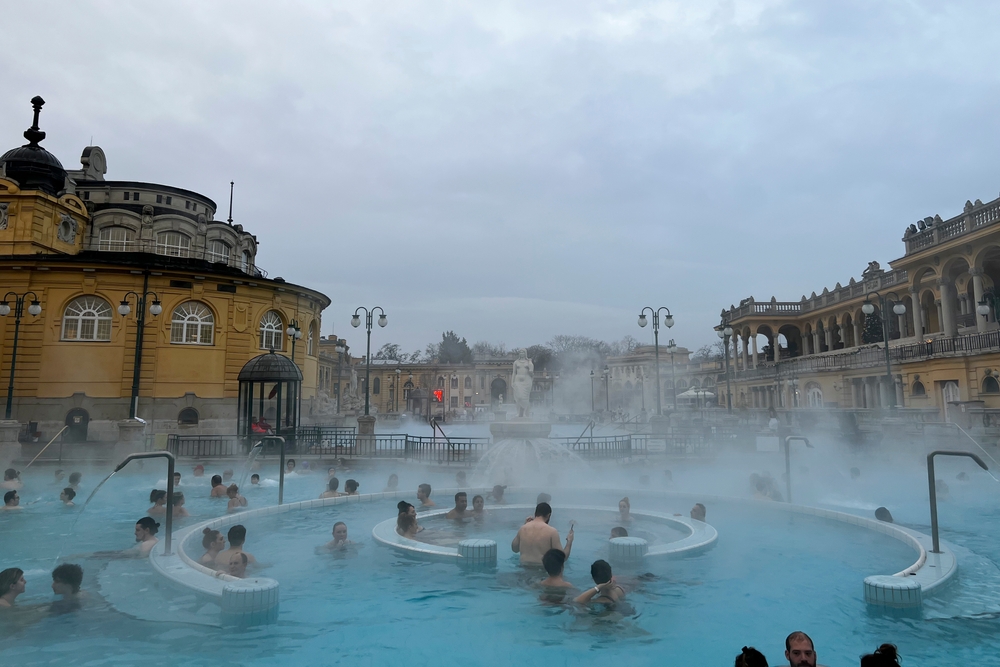
Budapest holds a title that few other world capitals can claim: the International Spa City. This is not merely a marketing slogan but a geological reality. Situated on a fault line where the hills of Buda meet the plains of Pest, the city sits atop a massive reservoir of thermal water. Every day, more than 120 natural springs push millions of liters of mineral-rich water to the surface, fueling a bathing culture that has remained unbroken for centuries.
A Legacy Carved in Stone and Steam
The story of Budapest’s waters began with the Romans, who established the settlement of Aquincum specifically to take advantage of the steaming springs. However, the most visible architectural influence today stems from the Ottoman occupation in the 16th and 17th centuries. The Turks viewed bathing as a spiritual and social necessity, constructing domed hammams that still stand today.
These historical layers create a unique atmosphere. In a single weekend, a visitor can transition from the medieval stone arches of a Turkish bath to the palatial, Neo-Baroque grandeur of the Austro-Hungarian era. This continuity of use is what makes Budapest unique; these are not museums, but living community centers where residents have gathered for generations.
The Architectural Icons
Among the dozens of facilities in the city, the Széchenyi Thermal Bath stands as the most famous. Located in the heart of City Park, its bright yellow walls and vast outdoor pools are iconic. It is perhaps best known for the sight of local men submerged to their chests in steaming water, intensely focused on games of “water chess.”
While Széchenyi represents the grand social side of the tradition, the Rudas Baths offer a window into the past. Its octagonal pool, sheltered by a massive stone dome supported by eight pillars, dates back to 1550. Light filters through small colored glass inserts in the roof, creating a tranquil, ethereal atmosphere that feels worlds away from the bustling city streets outside.
Health and the Mineral “Cocktail”
The appeal of these springs goes beyond relaxation. The water is naturally infused with a complex blend of calcium, magnesium, hydro-carbonate, and sulfate. In Hungary, balneotherapy—the treatment of disease by bathing in mineral springs—is a recognized medical practice often prescribed by doctors.
The high mineral content, while beneficial for joint health and circulation, does give the water a distinct, slightly sulfuric scent. To a newcomer, it may be surprising, but to a local, that scent is the smell of healing and heritage.
Navigating the Bathing Culture
To enjoy the Budapest spa experience like a local, there are a few cultural norms to observe. Most baths offer both “lockers” and “cabins.” A cabin is a small, private changing room that stays locked with your electronic wristband, providing a bit more dignity than a communal locker room.
Hygiene is paramount. Every visitor is expected to shower thoroughly before entering the pools. Furthermore, while the warm thermal pools are for soaking and socializing, the cooler lap pools have a strict rule: a swimming cap must be worn at all times. This distinction helps preserve the water quality and ensures that the different areas of the bath serve their intended purposes—one for fitness, and one for deep relaxation.
A Ritual for Every Season
One of the most magical aspects of the Budapest tradition is its year-round nature. There is a specific joy in sitting in a 38°C outdoor pool at Széchenyi while steam rises into the crisp winter air and snow falls on the surrounding statues. Whether it is a quiet morning at the intellectual’s favorite, Lukács, or a sunset soak overlooking the Danube at Rudas, the thermal springs remain the rhythmic heartbeat of the city.