

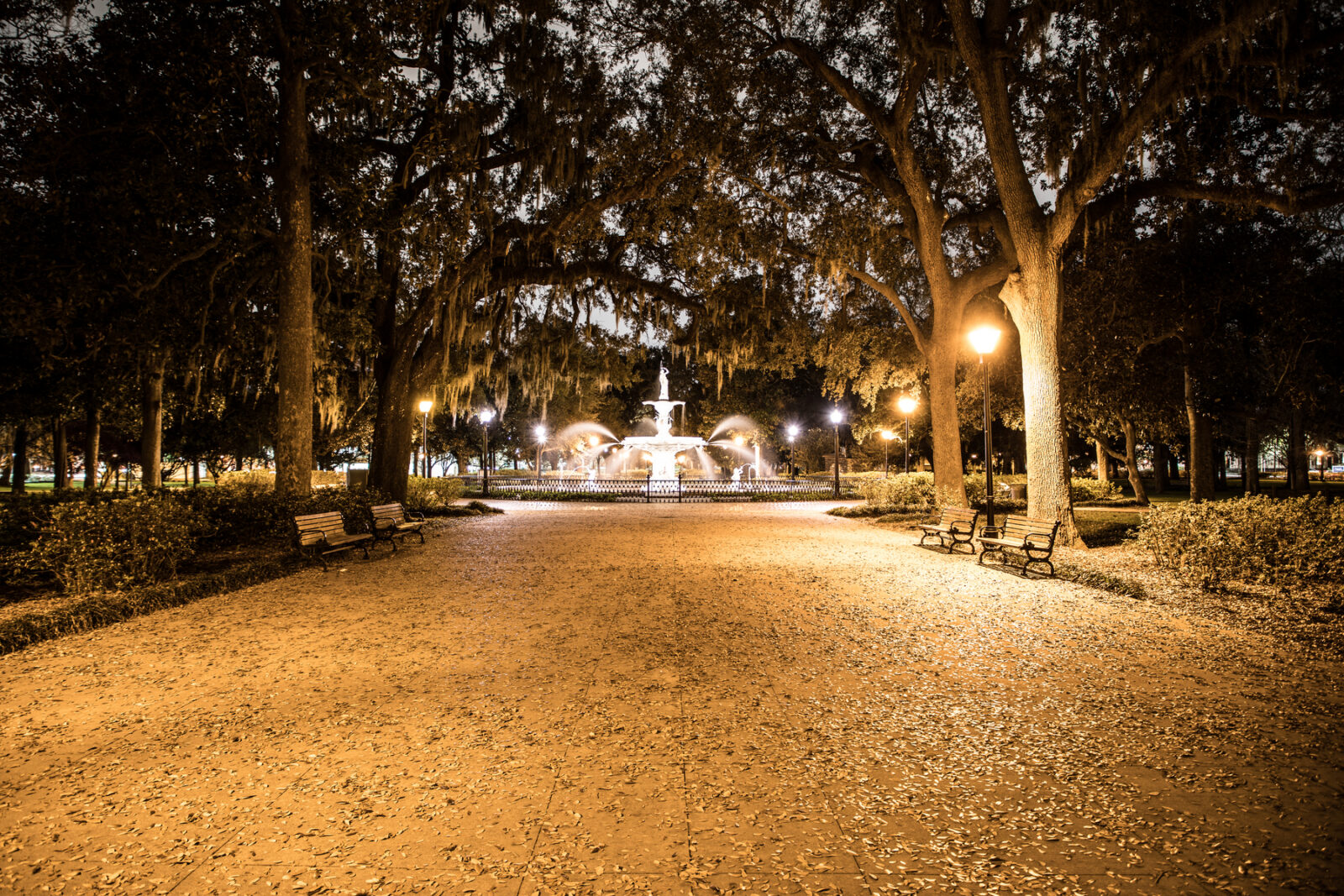
There is a moment, typically at dusk, when Savannah moves beyond its charming, historic facade and reveals its deeper, more melancholic soul. It’s when the heat of the Georgia day begins to lift and a faint, damp cool rises from the earth, and you find yourself standing beneath the massive, gnarled arms of an ancient live oak. Here, draped over every branch like a spectral, silver-green lace, is the Spanish moss. It captures the fading light, turning the twilight into a soft, hazy suspension of time and place. This is not just scenery; it is an atmospheric condition, an elegant, decaying beauty that forms the very core of Savannah’s “Southern Gothic” romance.
While the entire city feels gently haunted by this botanical curtain, nowhere is the experience more concentrated or more profound than in Forsyth Park. Wandering here under the vast, overarching canopy is to step into a natural cathedral where the air is heavy with history, humidity, and an undeniably intimate, slightly eerie charm.
The Geography of a Dream
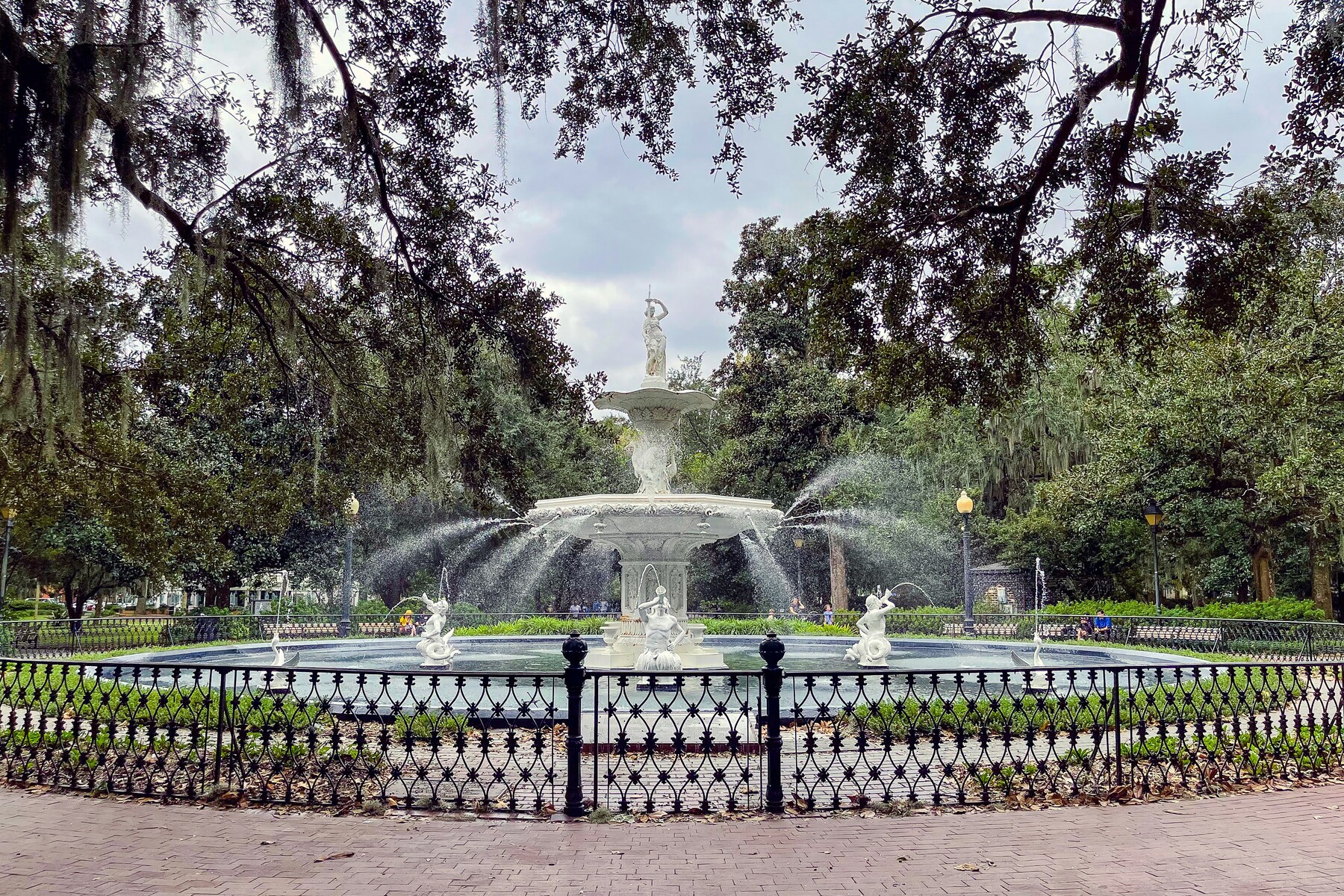
The 30-acre expanse of Forsyth Park is Savannah’s breathing heart, but its most iconic feature is not the grand, white cast-iron fountain at its northern end, nor the tennis courts and garden for the blind to the south. It is the mile-long promenade of live oaks, planted for both shade and show, that forms a continuous, shaded tunnel. This path is the stage for a specific kind of Savannah magic.
As you walk, the physical world seems to recede. The sound of traffic and the chatter of distant tourists are muffled by the dense canopy and the hanging moss. The scale is monumental; these are not mere trees, but living, ancient structures, their low-slung, massive branches creating a series of intimate, shaded chambers. The view isn’t horizontal; it is vertical, drawn upward to the chaotic, beautiful interweaving of wood and moss.
This creates a pervasive sense of sanctuary, and a very distinct vibe of romantic suspension. It is a place that feels simultaneously public and deeply private, making it the perfect backdrop for solitary reflection or a quiet, whispered conversation. The physical architecture of the trees and moss creates a natural privacy that invites you to slow down, to linger, and to simply be present.
Decadence in the Details
There is a delicious, slow-motion decay to the Spanish moss that is central to its appeal. Tillandsia usneoides is not a moss at all, but an epiphytic flowering plant in the bromeliad family (a cousin to the pineapple), that derives all its nutrients and water from the air and the sun. It takes a certain sophisticated sensibility to appreciate this quality. It isn’t the crisp, manicured beauty of a classical French garden; it is a wilder, more organic, and ultimately more resonant form of elegance.
This is the “Southern Gothic” element: beauty that is intertwined with impermanence and a touch of melancholy. The moss cloaks the trees in a perpetual, elegant mourning dress, a visual metaphor for the weight of history and memory that seems to permeate the city. Yet, at the same time, it is incredibly graceful, swaying with a ghostly, rhythmic motion in the lightest breeze.
The light plays a critical role in defining this romantic atmosphere. Savannah’s light is never harsh; filtered through the moss and the oak leaves, it is always dappled, soft, and warm. This “green light” is incredibly intimate. It changes through the day, turning from a soft, cool, silver-green in the morning to a deep, honeyed amber as the sun dips. The visual effect is one of continuous, gentle texture and movement, a living veil that shifts and re-shaping the world around it.
Practical Elegance and the Slow Walk
To experience the full romance of Forsyth Park and its oaks, one must resist the urge to treat it as a box to be checked. The best way to arrive is not with a guide, but simply to wander in. Savannah is a town built for walking, with a system of 22 squares that lead, inevitably, towards the park. This slow, deliberate approach allows the atmospheric pressure to build; you feel the influence of the moss long before you reach the main promenade.
While the park is beautiful at any time, it truly performs in the late afternoon and early evening. This is when the light is at its most flattering and when the sensory details—the damp-earth scent, the faint rustle of the moss, the cooling air—become most prominent. For those looking to fully immerse themselves in the “vibe,” packing a simple, elegant picnic (think a bottle of chilled white wine, local cheese, and good bread from one of the city’s bakeries) is a must. Find a place on a worn stone bench or spread a blanket on the grass and let the evening unfold around you. The experience of simply “being” in the park, with the iconic fountain shimmering in the distance and the soft, grey veil above, is more memorable than any planned activity.
Savannah’s Spanish moss is not a “top 10” attraction; it is the very fabric of the place. To walk under its canopy in Forsyth Park is to engage with the city on an emotional, atmospheric level. It is to accept a beauty that is raw, graceful, and utterly authentic—a reminder that the most compelling romance is often found in the softest light, the slowest moments, and in the timeless, draping embrace of nature.