

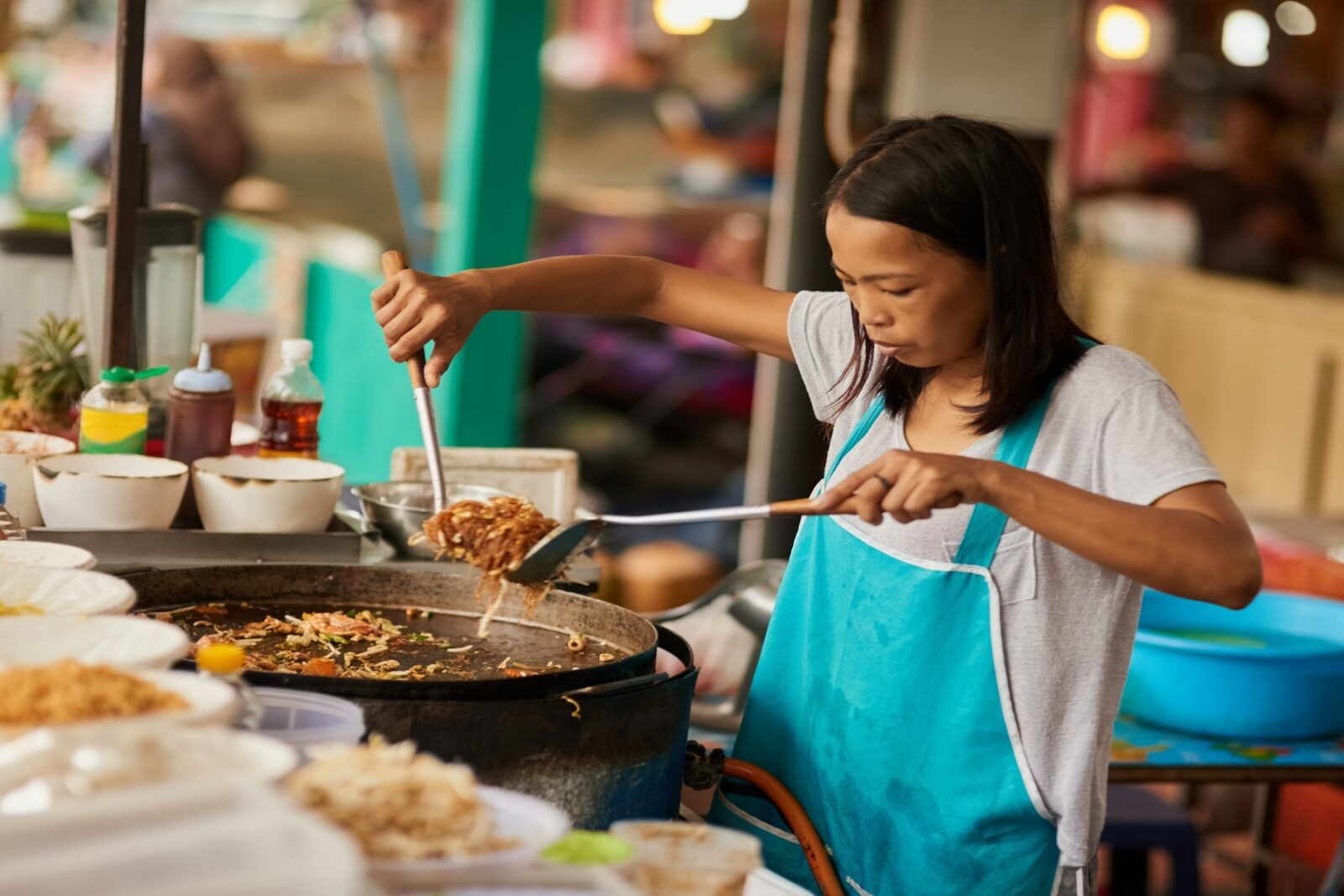
Bangkok is a city that truly wakes up when the sun goes down. As the afternoon humidity yields to the neon glow of the evening, the sidewalks transform into a sprawling, open-air kitchen. To walk through a Bangkok night market is to navigate a “tactile frenzy” of hissing woks, aromatic clouds of bird’s eye chili, and the rhythmic metal-on-metal clatter of spatulas.
At the heart of this chaos lies Pad Thai. While often dismissed as a “tourist dish” abroad, in the hands of a street-side Usta (master), it is a complex masterpiece of sweet, sour, salty, and spicy notes, flash-fried in a matter of seconds over a roaring flame.
-
The Midnight Legend: Thipsamai
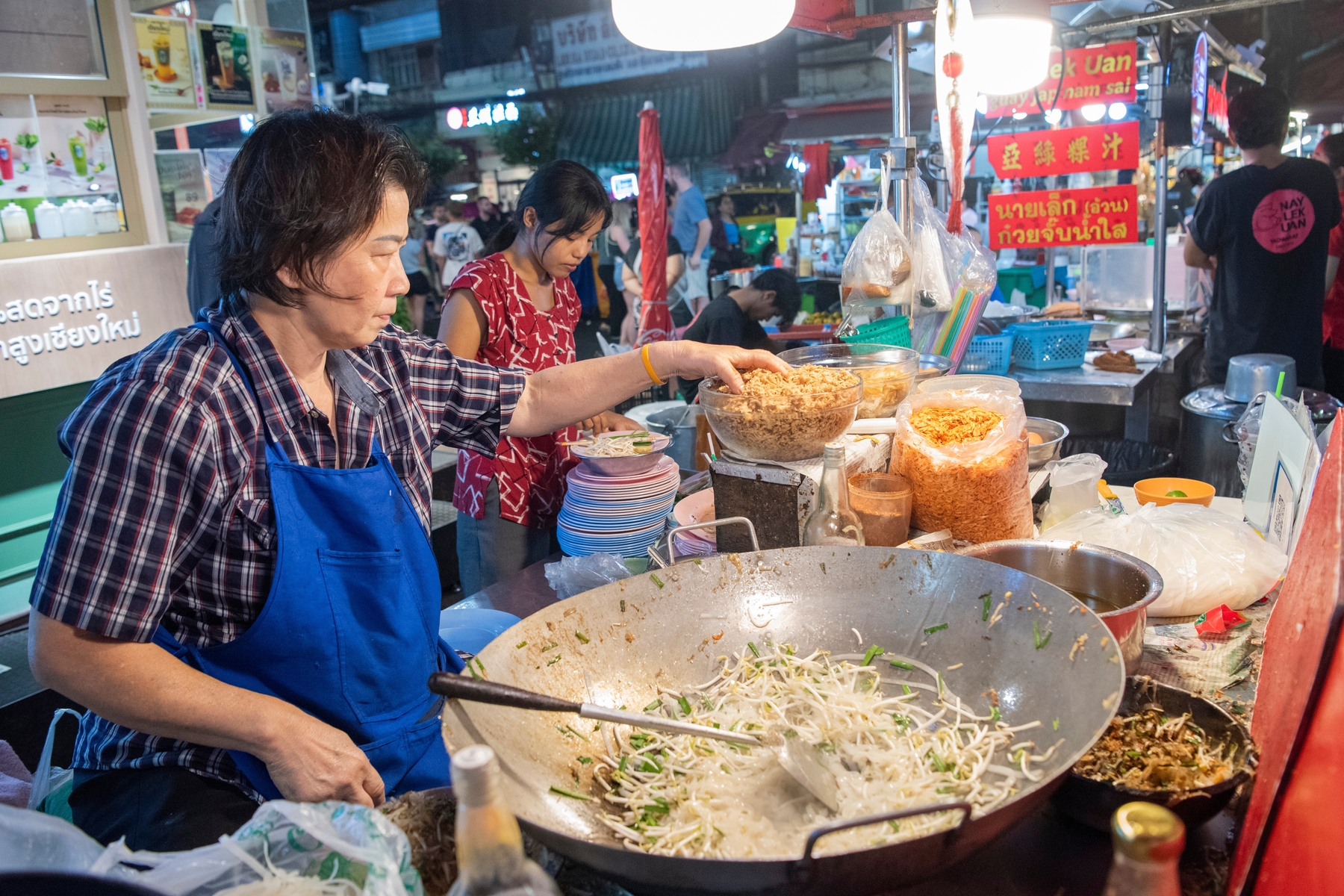
You cannot discuss Pad Thai without mentioning Thipsamai in the Old City (Phra Nakhon). While it has moved from a humble stall to a world-famous institution, the energy remains electric. The real show happens on the sidewalk, where cooks man a line of roaring charcoal stoves, tossing noodles with a speed that defies the heavy tropical heat.
Their signature is the Pad Thai Haw Kai Goong Sod—shrimp Pad Thai wrapped in a paper-thin omelet. The charcoal fire imparts a “breath of the wok” (wok hei) that you simply cannot replicate on a gas range. Despite the long queues of locals and travelers, the first bite of those thin, orange-hued rice noodles makes the wait entirely worth it.
-
The Street Corner Specialist: Baan Phadthai
Located in the historic Charoen Krung district, Baan Phadthai manages to bridge the gap between street-food soul and Michelin-rated refinement. Housed in a bright blue shophouse, it captures the nostalgic “Old Bangkok” vibe.
Their secret lies in the sauce, which uses high-quality tamarind and palm sugar to create a deep, caramelized base. Unlike the oily versions found in lesser markets, their Pad Thai Poo (with jumbo lump crab) is light yet intensely flavorful. It is the perfect spot for those who want the complexity of street flavors with a slightly more relaxed pace.
-
The Neighborhood Anchor: Pad Thai Mae Am
For an experience that feels like a hidden secret, head to Pad Thai Mae Am on Rama IV Road. This tiny, unassuming shop is a time capsule, with walls covered in old photos and a menu that hasn’t changed in decades.
Mae Am is a purist. She pre-soaks the noodles in a tamarind and palm sugar seasoning before they ever hit the wok, ensuring every strand is infused with flavor. The result is a darker, more savory noodle that perfectly captures the “Gospel of Fire” through its charred edges and smoky aroma. It is honest, unpretentious, and arguably the most authentic bite in the city.
-
The Market Chaos: Jodd Fairs and Beyond
In 2026, Jodd Fairs (the spiritual successor to the Ratchada Train Market) is the epicenter of Bangkok’s night market energy. Here, Pad Thai is served in cardboard boats amidst a sea of rainbow-colored fruit shakes and spicy pork “volcano” ribs.
Eating here is about the sensory overload. You stand shoulder-to-shoulder with thousands of others, the smoke from the satay grills drifting past your face while a street performer plays nearby. The Pad Thai here is fast, hot, and heavy on the crushed peanuts and dried shrimp, designed to be eaten on the move as you dive deeper into the market’s neon labyrinth.
The Anatomy of the Perfect Plate
- The Squeeze: Never skip the lime. The acidity is essential to cutting through the richness of the stir-fried noodles and palm sugar.
- The “Four Seasonings”: Every table in Bangkok has a condiment caddy (phuang phrik). A true local will add an extra spoonful of dried chili flakes and a dash of fish sauce to customize the heat and salt to their specific liking.
- The Banana Blossom: Authentic Pad Thai is often served with a wedge of raw banana blossom and Chinese chives. They provide a bitter, crunchy contrast that resets your palate between bites.